
nano-zyrkel released

Full Zyrkel release coming soon.

Be the first to know. Subscribe for launch updates.

Zyrkel

/ˈsɜːrkəl/

Docks to anything. Learns from everything. Forgets nothing. Lives beyond your machine.

A self-learning cognitive unit that docks to any program, connects systems that were never meant to talk, and scales from one to thousands — even when your laptop is off, nano-zyrkels keep working. Open source, free, and fast. This is zyrkel.com.

165K
Lines of Rust
25MB
Binary Size
70+
MCP Tools
21
Rust Crates
120+
API Endpoints
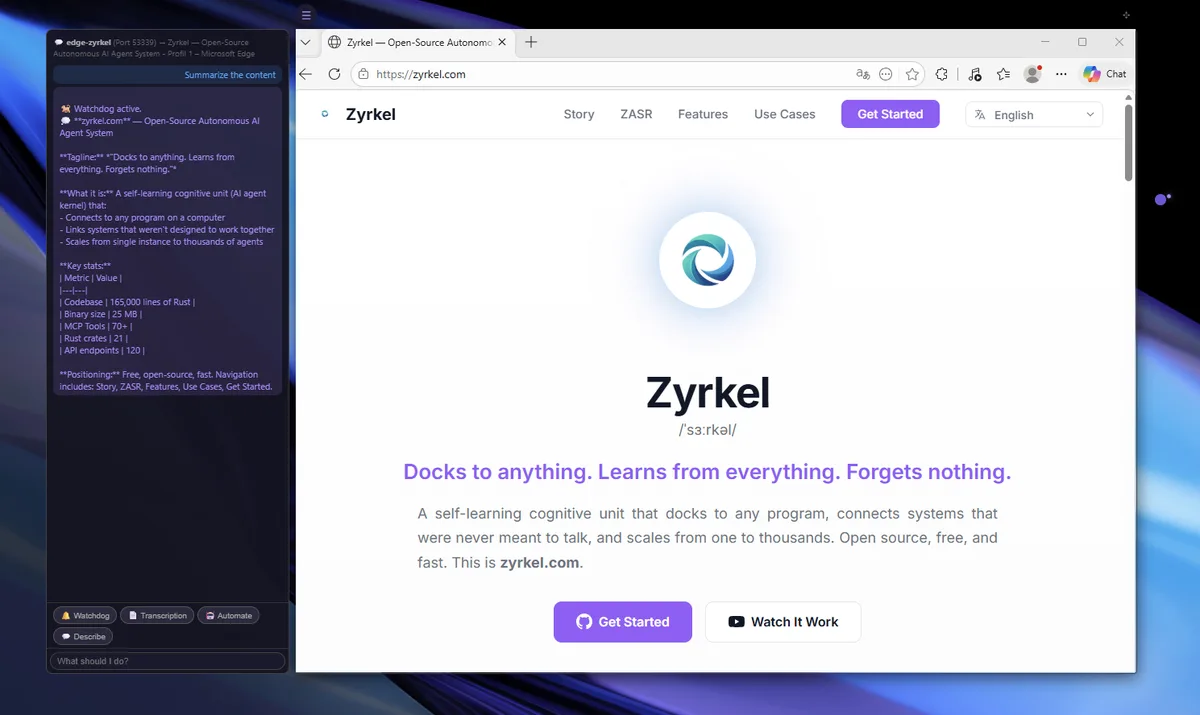
Zyrkel Cutout Mode

Cutout Mode — docks to any window, works alongside you

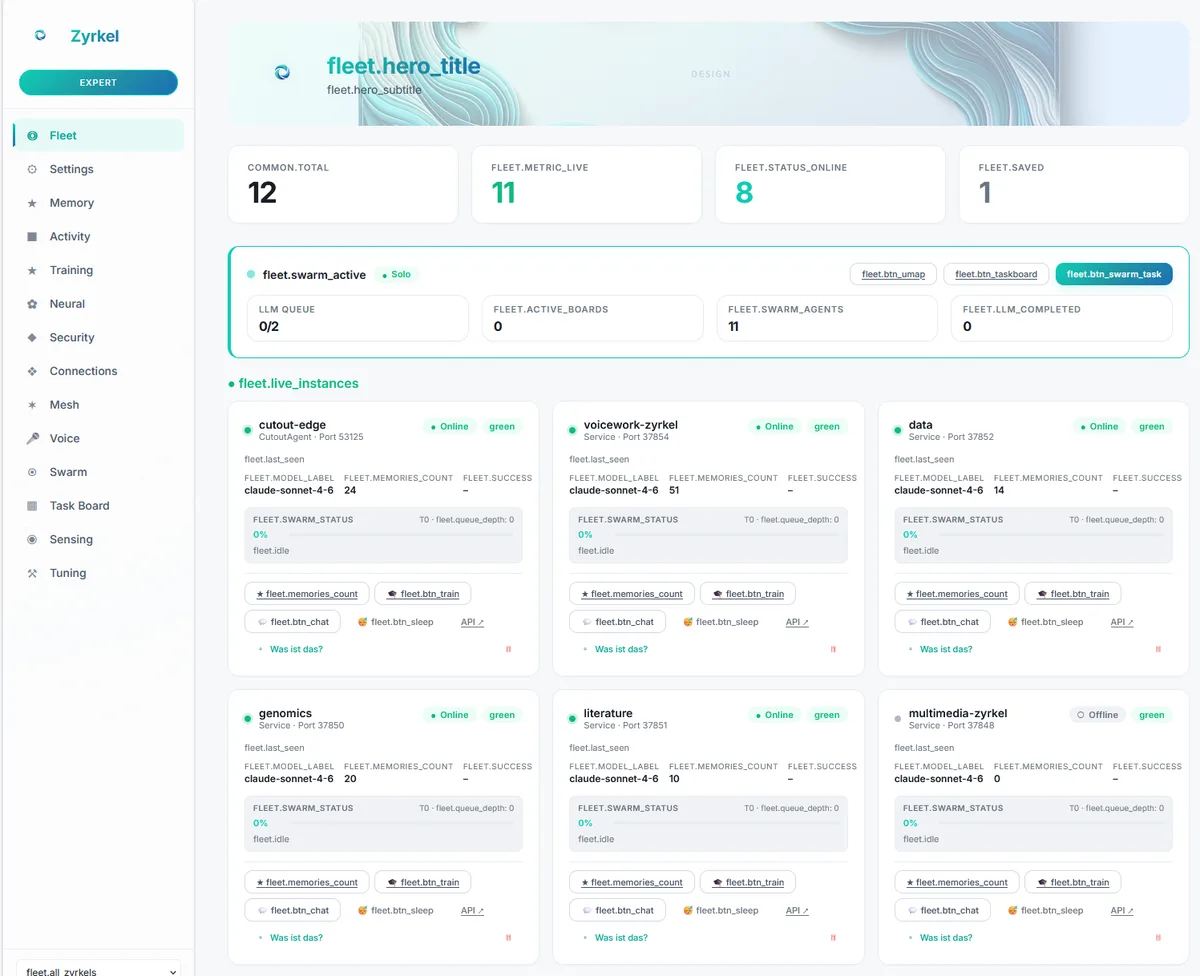
Zyrkel Fleet Dashboard

Fleet Dashboard — 6 Zyrkels, each specialized, all coordinating

Zyrkel Session Bar

Session Bar — picks up where you left off, every morning

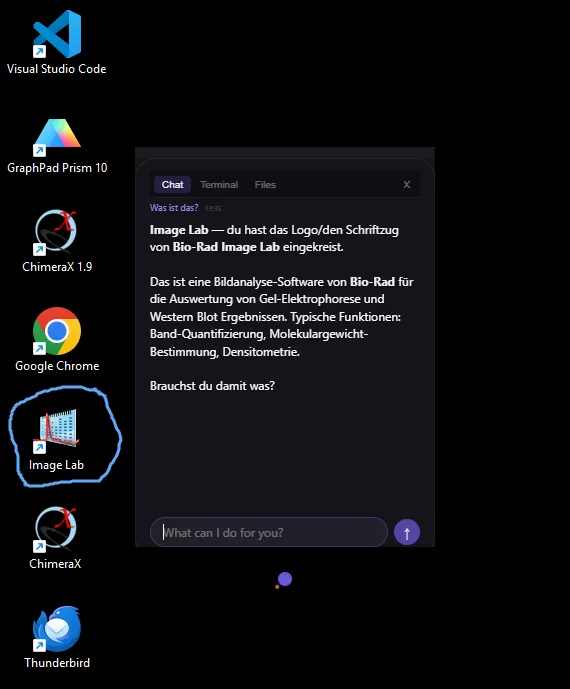
ZASR — circle something on screen, Zyrkel identifies it

ZASR — circle anything on screen, Zyrkel tells you what it is

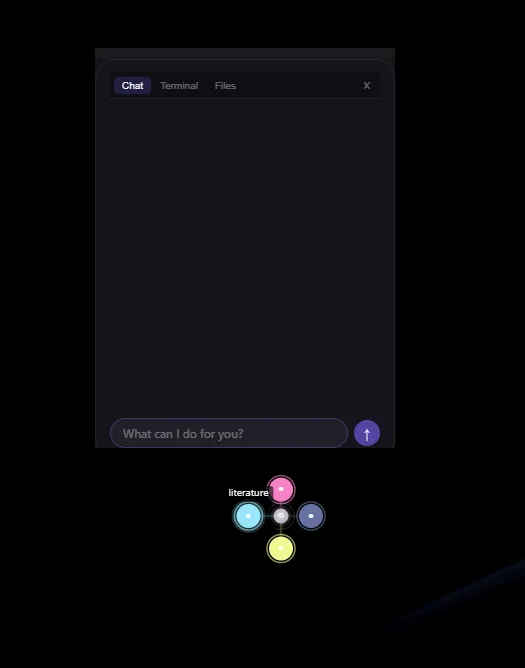
Multi-Dot Session — 4 Zyrkels working together

Multi-Dot — multiple Zyrkels on your desktop, each with their own role

Born in a genetics lab. Built for everything.

Zyrkel started at the Institute of Human Genetics at UKE Hamburg. The original problem was simple: genomics pipelines are complex, parameters change between datasets, SLURM jobs run at 3 AM — and most students and researchers can't code. Bioinformatics tools should be accessible to everyone in a lab, not just the one person who knows Python. So a system was built that lowers that barrier to zero: tell it what you need, and it handles the rest. It remembers every parameter, every outcome, every lesson learned.

Then the memory system generalized. Tools were added — not just for genomics, but for anything. A desktop overlay appeared that could read the screen and respond in context. Voice followed. Then came the feature that changed everything: dock a Zyrkel to two programs that have no shared API, and they communicate through it. Then the fleet system arrived — one Zyrkel became two, became ten, became hundreds, each specialized, each learning independently, all coordinating.

Today, a single 25MB binary — or a fleet of thousands — runs on your laptop, your HPC cluster, or your Kubernetes infrastructure. It handles genomic variant classification and Excel spreadsheets. It monitors heartbeats and writes emails. It generates ideas and executes them autonomously. It is a cognitive unit that docks wherever it's needed.

nano-zyrkel — Agents that never sleep.

Close your laptop. They keep working. A nano-zyrkel is a tiny autonomous agent that lives on GitHub and runs 24/7 — for free. No server needed.

Tell it what to watch. It monitors websites, tracks prices, alerts you when something changes, and remembers everything as Git commits. One JSON file. One push. Done.

  • Watch any website, API, or RSS feed — get Telegram alerts when something happens
  • Track prices, metrics, or data over time — automatic time series
  • Ask questions in plain language — "Is there a new version available?"
  • Runs on GitHub Actions — zero cost, zero infrastructure
  • Every result is a Git commit — built-in audit trail
nano-zyrkel — autonomous agents on GitHub

This runs on a nano-zyrkel.

A live widget, powered by nano-zyrkel. One of many things you can build with it.

VUS Tracker — Variant Intelligence Platform

This widget tracks genetic variants of uncertain significance (VUS) across ClinVar, the world's largest clinical variant database. It auto-updates the variant database weekly, and if a variant you're watching gets reclassified — pathogenic, benign, anything — it sends you an email. No manual checking. Powered by a nano-zyrkel.

Behind this widget, a Rust-based nano-zyrkel computes millions of endpoints from a variant database in real time — genome coordinates, classification histories, concordance matrices, survival statistics — and visualizes them live in your browser. 63KB of JavaScript. No frameworks. No loading spinners.

  • Interactive genome browser with pan and zoom — built in pure SVG
  • Phenotype search: type a symptom, find candidate genes instantly
  • Classification drift detection — see how variants change over time
  • Kaplan-Meier curves for VUS resolution rates
  • Concordance matrix — spot conflicting interpretations across labs
  • Auto-updates weekly from ClinVar, HPO, OMIM — zero maintenance

This is one use case. nano-zyrkels can be anything: price trackers, uptime monitors, literature scanners, data dashboards — any autonomous task that runs on a schedule.

Enter nano-zyrkel Showroom View source

ZASR — Zyrkel Augmented Screen Reality

A new way to interact with your computer. A 48px dot lives on your screen, always present, always aware. It reads what you see through real-time OCR, understands context, and acts.

Circle something on screen — Zyrkel identifies it. Point at a UI element — Zyrkel explains it. Draw an arrow between two windows — Zyrkel connects them. And it draws back: need to install a printer? Zyrkel walks you through it step by step, right on your screen — arrows pointing at the right buttons, highlights showing where to click, a live walkthrough for any technical problem you have.

  • Real-time screen reading with live OCR and PixelDB recognition
  • 14 overlay widget types: arrows, highlights, bubbles, HUD, spotlights
  • Cutouts: dock a Zyrkel to any program — Excel, browser, terminal, anything
  • Cognitive state awareness: adapts when you're in deep work vs. browsing
  • Spatial conversations: draw on screen, Zyrkel responds in context
  • Voice control with wake word, Whisper STT, and native TTS — all in Rust
ZASR

Make any program talk to any other program.

Two programs. No shared API. No integration layer. No middleware. They were never built to communicate. Dock a Zyrkel to each. Give them their own ports, their own memory. Now they talk.

Excel sends data to a database. The database triggers an email. The email updates Slack. No custom code. No integration platform. Just Zyrkels, docking and bridging.

  • Each Zyrkel runs on its own port with its own persistent memory
  • Peer networking via mDNS auto-discovery and federated webhooks
  • Platform-independent: Windows, macOS, Linux — mixed environments work
  • Scales from two connected programs to enterprise-wide orchestration
  • MCP server compatible with Claude, GPT, Gemini, Cursor, Windsurf
  • OpenAI-compatible API — drop-in replacement endpoint
Zyrkel Connect

Everything a Zyrkel can do.

One binary. Unlimited capabilities.

🧠

Persistent Memory & Neural Network

Every interaction makes it smarter. A 4-tier neural memory that grows with use — from simple recall to adaptive pattern recognition. Learns from conversations, extracts knowledge automatically, tracks where every fact came from. Teach a workflow once — Zyrkel executes it forever.

Execution & Autonomy

70+ tools, 1000+ pre-compiled actions with <1ms lookup. 4 autonomy levels from supervised to self-governing. SOP engine, cron triggers, pattern triggers. Task planner with safety classification.

🔊

Voice & Communication

Whisper STT, Edge TTS, wake word detection — all native Rust, no Python. 30+ language packs for the interface. Voice in English and German, more coming. Telegram, Slack, email built in.

🌐

Fleet & Scale

From 1 Zyrkel to thousands. Care System with watchdogs, heartbeats, and health monitoring. Divergence Router for statistical auto-scaling. Swarm patterns: MapReduce, Consensus, Pipeline, Mesh. HPC/SLURM and Kubernetes ready.

🔒

Privacy & Safety

8-scanner egress filter (ICD-10 codes, credit cards, API keys, patient IDs). 5-layer safe mode (GREEN to BLOCKED). Reversible pseudonymization. Hearing privacy. Runs locally — no cloud dependency.

🧬

Science & Data

Short-read and long-read pipelines. De novo assemblies. Variant calling and annotation. ACMG classification. Transcriptomics, multi-omics, visualization. Literature watching. Excel, Word, PDF processing.

💡

Creative Engine

A novel algorithm for creativity in LLMs. Syllable mutation, random-word injection, phonotactic filtering, and gradient ascent — breaks LLMs out of predictable patterns and into genuinely surprising territory. Classify → Ideate → Elaborate → Build.

🤖

nano-zyrkel

Autonomous agents that live on GitHub and run 24/7 for free. Watch websites, track prices, monitor APIs, get Telegram alerts. One JSON config, one push — zero infrastructure. 5 agent types, LLM-powered conditions, Git-versioned results.

🔌

Integrations

MCP server for Claude, GPT, Gemini, Cursor, Windsurf. Plugin system with 6 types and hot-reload. Browser extension. 11-section dashboard. Multi-LLM support: Claude, GPT, Ollama, any OpenAI-compatible endpoint.

Built for your workflow.

Genomics, HPC, and Scientific Computing

  • Short-read and long-read pipelines, de novo assemblies, variant calling, annotation, visualization
  • Transcriptomics, multi-omics integration
  • Classify variants with the full ACMG/AMP framework
  • Parse VCF, BAM, and FASTQ files natively — no external tools needed
  • Monitor literature: PubMed and ClinVar watching with automatic notifications
  • Submit and track SLURM jobs, generate Snakemake/Nextflow pipelines
  • Zyrkel remembers which parameters worked on which dataset — permanently
  • Works with your existing HPC infrastructure — SSH, SLURM, any cluster setup
  • True swarm intelligence: no central controller — each Zyrkel observes, adapts, and influences its neighbors through behavior, producing emergent decentralized coordination
  • nano-zyrkels for literature watching: monitor PubMed, ClinVar, or any journal — get notified when new papers match your keywords, 24/7

APIs, Plugins, and Infrastructure

  • MCP server with 70+ tools — works with Claude, GPT, Gemini, Cursor, Windsurf
  • OpenAI-compatible API endpoint
  • 120+ REST API endpoints for full programmatic control
  • Plugin system with 6 types (Tool, Integration, Transport, Panel, Hook, Encoder)
  • Hot-reload plugins without restart, JSON-RPC communication
  • 21 Rust crates, modular architecture, feature flags for minimal builds
  • Kubernetes StatefulSet generation, headless service discovery
  • Federation via HMAC-signed webhooks with Hybrid Logical Clock ordering
  • nano-zyrkels as CI/CD watchdogs: monitor APIs, track uptime, alert on breaking changes — runs as GitHub Actions, zero infrastructure

Your Desktop, Your Rules

  • Install the 48px Desktop Dot — always on top, always learning
  • Teach Zyrkel workflows with plain language — it remembers and executes them
  • Connect any programs through Zyrkel — and operate them: Zyrkel doesn't just bridge, it clicks, types, reads, and controls
  • 33 language packs: all 24 official EU languages plus the 10 most spoken languages worldwide
  • Voice control in English and German, more languages coming soon
  • Communicate via Telegram, Slack, or email — Zyrkel bridges them all
  • Privacy first: runs locally, 8-scanner egress filter, no cloud dependency
  • Choose your LLM: Claude, GPT, Ollama (local), or any compatible endpoint
  • Dashboard with 11 sections: Fleet, Memory, Neural, Security, Voice, and more
  • nano-zyrkels: set up agents that watch websites, track prices, or monitor anything — they keep running even when your computer is off

Get started.

Clone, build, run. Headless server + Desktop Dot.

Desktop App (includes server) coming soon
git clone https://github.com/christian-schlein/zyrkel
cd zyrkel/crates/zyrkel-desktop
cargo tauri build --features full
nano-zyrkel (GitHub Agent)
git clone https://github.com/schlein-lab/nano-zyrkel
cd nano-zyrkel
cargo build --release
./target/release/nano-zyrkel run hats/watcher.json

Windows is the most mature platform today. Linux coming soon. macOS under construction.
zyrkel.com

Open source. Free. From the lab to the world.

Zyrkel is developed by Christian Schlein, human geneticist at the Institute of Human Genetics, UKE Hamburg. Every line of code is open, every feature is free, and contributions are welcome.

Impressum

Share VUS Tracker

WhatsApp Telegram Email

Embed on your website